Tuesday, December 16, 2014

Sermon on the Weeds and Wheat

As I move through the ordination process, I have been given the opportunity to preach a few times at some local churches, including my home church, College Hill UMC (CHUM) in Wichita. I'll be sharing the text of my sermons here. I am scheduled to preach December 28th, and I will share that sermon here afterwards.

Today's sermon was preached July 20, at CHUM. It was concerned with the Parable of the Weeds and Wheat, from Matthew 13.

Let me tell you a little about myself.

I grew up out in Butler County, in the Towanda and Benton area. I graduated from Circle High School and spent two years at BCC before going to OCU, a private UMC college in OKC. I studied political science, and spent time working in politics in Oklahoma. My family and I moved back here in January, and we currently live out in Towanda. I now am working as the Executive Director of SCDP. But my chief path in life now is Methodist ministry.

Now, despite the fact that I grew up in rural Butler County, amidst wheatfields and cow pastures, I don't happen to know the first thing about farming. Growing things is not a forte of mine, although that doesn't mean it isn't something I dream of being good at. We have tried our hand at household herbs. We had dreams of a bountiful vegetable garden in our backyard in Towanda, and even made far-off plans to move onto a farm outside of town and take up farming.

Does the fact that we are moving into apartments near here in the next couple weeks tell you how that worked out for us?

We had this dream because we love organic and natural foods! We wanted to live off the fruit of our own labor, to pare our diet down to locally grown and raised products. We try to eliminate sugar and processed foods from the things we eat. And those things certainly are still important to us!

But the actual cultivation kicked our tails a little bit. Growing things is hard! Not only does it take countless hours of difficult planning and work, it takes a learned and lived knowledge that, frankly, neither Ari nor I have. Not that we can't learn it! But trying to raise an acre's worth of organic produce? A little out of our range of ability at this point.

So we decided, maybe we should just stick to something smaller. Get some experience under our belt first. Now, our little house in Towanda has two flower beds out front, one on each side of the front step. When we moved in in January, they were fairly covered in leaves and old grass clippings and bits of trash the wind carried in. Amidst all this were a couple of scraggly bushes on each side poking up, looking fairly miserable in the winter winds.

I decided that I, with this font of gardening skills I believed I was just naturally endowed with, was gonna make those flower beds beautiful. I could just picture the majestic azalea bushes and daisies and forget-me-nots that would make our home the most welcoming abode in all Towanda come spring. So once the weather warmed just a bit, probably in early March or so, I got out there and I pulled out all the trash and raked out all the leaves and grass clippings, and then I took one of those tall blue Garden Claw things that I got from my grandma and set in tilling up the soil between the little sad bushes, so that I could mix in some nice organic compost. Well, in the left-side bed, as I went to town turning and tilling, I noticed a real tough stem and root system growing between the bushes.

Now let me tell you: if these bushes looked bad, it was nothing compared to this “thing” trying to hold on between. And I just knew, this was some kind of noxious weed-tree thing and by golly it was coming out of my glorious flower bed! So I dug and twisted and cut and pulled and before long I got that thing out of the ground and deposited in its rightful place: the trash heap. Good riddance to you, weed. Nothing will blight my flower beds!

Now all this pulling and digging on the left side bed took up a good portion of an afternoon, so I called it a day and put away the tools, determined to get back out the next day and go after the counterpart weed growing between the bushes in my other flower bed. But, as this state tends to experience pretty often, it turned miserably cold and rainy the next day, and by the time it got nice again, I had lost interest in attacking that other weed. So it stayed, and I kept intending to get out there and attack.

Before long, spring appeared and the scraggly little bushes out front started to perk up and become downright impressive. And gosh darn it, wouldn't you know it, that little noxious weed-tree sprouted up one night too and next thing you know my grandma (the ultimate gardener; her backyard would put Botanica to shame) came by and admired the beautiful white and pink peonies I had sprouting right there between the bushes!

And, I'm sure she noticed the ugly bare spot in the middle of the left bed too.

And sure just about everyone who drives by our little house notices it too.

So if I learned anything this spring it's that I am not, in fact, a gardener. Or a farmer. Or someone who should be let within one hundred yards of this community garden out behind the church here.

But today's scripture provides some balm to my bruised ego. In this story, a landowner plants his field with wheat. And that wheat sprouts up and bears grain and all seems well. But then, one day, the farmhands notice something: it's not just wheat out in that field. There are weeds growing everywhere too! Somehow, someway, their hard work in planting that field went awry, and I think it's safe to infer that they are worried about their job security. Think about it! Their job as farmhands is to mind the master's fields. And so when one of those fields yields weeds just as much as wheat, they are probably rightfully concerned that their employer is going to question their ability to do their job.

See, even the pros get it wrong!

Before we go on, let me note something that might shed some light on the poor farmhand's plight, and maybe help them make their case before the master as to future employment opportunities. In the Middle East, there is a common weed known as darnel. In the early stages of growth, darnel looks just like wheat. It's identical, and distinguishing between the two is next to impossible. Only at the point of maturity, when the wheat yields grain and the darnel yields nothing, is it possible to tell them apart. So even if the farmhands were diligent about weeding regularly, there really is no way they could have done anything earlier about this problem.

So anyways, the farmhands work up their courage and they decide to go talk to the landowner. And they have a plan! Instead of just breaking bad news, they will have a two-pronged attack: first, they will subtly remind the landowner that this “Good seed” was provided by him? How in the world did the seed he provided turn out so bad? And secondly, they have a plan of action: they will soothe him telling him, we will take care of these weeds. No problem.

So in they go and they ask him, “Master did you not sow good seed in your field? Then where could these weeds have come from?”

But the master knows his seed was good. And he knows the field was tilled and prepared and everything they did was in order. And so he easily knows where the weeds came from, and he answers them calmly and matter-of-factly. “An enemy has done this.”

Now the farmhands are feeling good. They are off the hook! But they still want to win some brownie points here. So they tell him, “Don't worry boss! We got this! We will go out and pick all these weeds. It will be like this never happened!”

And the master is ready for them again:

STOP.” he says. “Don't do anything.”

Can't you just picture the farmhands, all filing towards the door, feeling both relieved and like hard workers, all the same time, come to a screeching stop? “STOP? What is this guy talking about? Why wouldn't he want us to get rid of these weeds?”

The master continues: “In gathering the weeds, you guys are sure to uproot a good amount of my wheat too. Let them continue to grow together, and at harvest I'll tell the reapers to collect the weeds first and get rid of them.”

What he basically tells his farmhands is, guys, that isn't your job. I hire reapers to do the reaping. I don't need you doing the job. You are to tend the fields, continue to help everything out there grow and flourish. That's it. But when it comes to harvesting, to rooting out the weeds from the wheat, just STOP. Don't do anything.

I haven't preached in about two years. So when Kent asked if I was interested and I told him sure, I made a beeline for the lectionary verses. I figured there had to be one that wouldn't be too tough on me, one I could really run with and get into the swing of preaching again with. And there certainly were. And even if there weren't no one said I have to stick to the lectionary. However, when I sat down and read this parable from Matthew about a month ago, I remember looking at Arianna and saying “That's a tough one for me, as a progressive Christian. I think I'll stay away from that story.”

And Ari said, “I think that's a pretty good reason to focus on that one.”

It's hard for me because I like to be right. And I don't like to just be right, I like to also point out when other people are wrong. Two of my favorites areas to do this are politics, and religion. There are few things in the world that get me rolling like seeing one of my more conservative friends say something crazy on Facebook.

I'm that annoying guy on Facebook who fights with everyone.

And truth be told, I think there are a lot of us liberals and progressives who absolutely love it when we hear someone start speculating on the just where the Garden of Eden is located.

Or where Noah's ark landed after the flood.

Or my favorite: how mankind lived alongside dinosaurs about 6,000 years ago.

Oh man.

There is nothing I want to do more than smack that down. I've got my Darwin pocket reader ready to go, I've brushed up on the origins of the universe and the Big Bang, and I know more about carbon dating than just about any non-geologist should actually know.

It feels good to weed out that crazy stuff, right?

Christians in general like to do that. One of the key features of modern Christianity is denominationalism. Did you know there are 217 Christian denominations in the United States alone?

Whenever we disagree on something, whether its the nature of the sacrament, or women in the pulpits, or even what kind of worship music we use, the answer to the conflict all to often becomes a split.

We just want to pull those weeds. We think it will make our church stronger.

We are seeing these stormclouds today in the UMC. Our denomination is the only non-evangelical Protestant denomination that has not taken an open and affirming stance towards LGBT people, now that Presbyterians did about a month ago. Isn't that sad?

And yet we know that two years from now, at General Conference, we will make a decision. And no matter what that decision is, a group of Methodists are going to be angry. And that group of Methodists will probably leave. And Methodists on the other side will take an attitude of “good riddance.”

More good weeding.

But is it really?

We see in this story today Jesus seeming to tell us the opposite thing. Instead of weeding that field, instead of seperating the wheat from the weeds in an attempt to make the field a better place for the wheat to grow, Jesus teaches us that in pulling these weeds, in our attempt to make the church “better” we are loosing something irreplaceable.

Now in the story, what would be lost is good wheat. In a pre-industrial agricultural society, every grain is precious! People were starving in first century Palestine. It was imperative that the harvest be maximized. They needed to get as much out of that field as possible. And while it seemed to the farmhands that the best way to do that was to pull the weeds, the master understood: you have to let the crop grow. You have to bring it all along. You have to let it come to maturity and then you can see what is weeds and what is wheat.

I sincerely believe that it is the same in the church today. If we want people to change, if we want them to come around to our side on any issue, we have to bring them along. We have to keep them in the fold.

And it's hard on an issue that has as many real world consequences as the full inclusion of the LGBT community. Those who are advocating for a continuance of exclusive and condemnatory language in our Book of Discipline are people who I don't necessaraily want to be in fellowship with. They feel to me like people with an outlook that the complete antithesis of what I take Christianity to be. How I would love to say “Sayonara.”

But if full inclusion is inevitable, and I think it is, and we allow it to break our denomination, then where are those who leave ten years from now? Or perhaps the better question is, where do we want them to be? Do we want them to hold these same exclusionary positions in ten years? Or do we want them to see the love of God realized in our LGBT brothers and sisters, do we want them to realize that they were wrong but they become right and participate fully in the inclusive kingdom Jesus described to us?

We obviously want them in that second category. And the only way to get them there is not through exlcusion. It's not through weeding them out. We have to let them grow with us. We have to bring the crop to maturity and see the fruit it bears.

Brian McLaren is one of my favorite Christian thinkers and writers, and he recently wrote a blog post that addressed the UMC and the way forward on inclusion. He laid out five different scenarios of action for the church, and in the end he made a really good point: no matter what action we take, whether it be full inclusion, full exclusion, partial inclusion, partial exclusion, or standing pat: people are going to leave.

It's inevitable. It's what we Christians do. And frankly, if the church doesn't act with justice and love for all of God's people, I understand that impulse. I will feel it myself.

But if schism is inevitable, how do we minimize it? If we know and feel that the church will act to welcome all in, what can we do to make sure we bring every one along and help them to grow to a place where they can also have an affirming love for others?

I blogged on this question after McLaren did, and I opined that the best way forward was for the church to take two actions: first, to follow the Presbyterians in allowing local congregations to make decisions about how open they will be, allowing churches like CHUM to practice love the way we know it should be while allowing churches that aren't there yet to get there at their own pace. And second, we need to pass a resolution stating our support for and love of the LGBT community and condeming any and all actions and words that discriminate, promote intolerance, or convey any message that is not steeped in love and acceptance of all God's children.

The impulse to pull weeds pervades our faith. We feel it all the time. Let me give you a personal example: I have friends and family members who aren't as progressive theologically as myself. And when I get into a theological discussion with them, whether its the nature of hell or the prosperity gospel or Christian nonviolence, I feel compelled to open the floodgates and question everything they believe and try to force them to agree with me. And I can carry on these debates for hours on end. Just ask Arianna. She's seen it.

But recently I've come to a new conclusion: those debates do no good. I can argue and argue and argue until I'm blue in the face and I am not really going to change their minds. Even if it seems like I did, it's simply like the seeds planted in rocky soil that Kent talked about last week: shallow, with no roots. And all I had sown was anger and resentment and divisiveness.

And it's because, they aren't where I am in my spiritual journey. They are where they are, and I need to be ok with that, and most of all: I need to find that middle ground where can be Christians together, in unity.

It was like the field owner was speaking to me, saying: STOP. Don't do anything.

Tend to them. Grow with them. Let them come to fruition. But stop trying to pull out the weeds. You are just gonna pull the wheat too.

I don't mean to make this sound like a “Call to inaction.” Far from it. This can be a dangerous parable, because I think it has been used a lot in history to justify inaction on a whole host of issues. The traditional and easy interpretation here is that we are to wait until the life after death for justice and peace and mercy to be realized. But I definitely don't think so. What I'm saying is, we need to act in a different way than is common. We need to act with an overwhelming love and acceptance of others, instead of in a way that induces schism and distrust and brokenness.

Acting with love, acting in a way that is completely unfamiliar to our normal way of doing things, is central to the Christian life. It means making the uncommon, common; the strange, familiar. It means finding those people who we are so angry at over this, and so many other issues, those people who seem to condemn and exclude as easily as breathing, and show them the redeeming, all-encompassing love of God. It means telling them, “We love you, we are brothers and sisters, we can be one.”

Its not easy. Its not what seems like the right way to deal with injustice and intolerance. But its the kingdom way. Its what Christian love looks like. We shouldn't put off radical and “wasteful” love, as Bishop Spong describes it, until the great hereafter.

As Shane Caliborne says, “Jesus' weeds-and-wheat parable was not meant for heaven; it was not a utopian dream. It invoked heaven on earth."

What I'm saying is, don't garden like I do. Don't just get all gung-ho and start pulling things left and right.

Rachel Held Evans is one of my absolute favorite Christian writers right now. And just this last Friday, she wrote about this verse and had some really great stuff to say. Her lens was the increasing violence in Gaza, and the idea that a war like that can be waged with “minimal civilian casualties.” Let me highlight the key passage from her message, because I think it is really relevant to what we’ve been thinking about this morning:

As reports of civilian casualties mount, we see that, just as Jesus warned, human attempts to “root out evil” on our own, by force, result in the destruction to innocent lives. Like it or not, this parable challenges (perhaps even mocks) our notion of “precision airstrikes,” of getting rid of the “bad guys” without hurting the “good guys.” The fact is, we don’t see the world as God sees it. We are not equipped to call the shots…..”

Then, skipping ahead just a bit:

“…the instructive call of this parable remains the same: to let God do the farming. God is the judge-not you, not me, not kings, not president.”

It's hard to stand aside and let things go sometimes. But maybe we should. Maybe we should let God do his work, let God reap the fields. In the meantime, we can tend to them and trust that in time, if we show them God's love-and patience-, they will bear wheat too.

Wednesday, July 2, 2014

Pope Francis and the Wayward Focus of American Christianity

This right here is why I really, really like Pope Francis:

He was asked about a blog post in the Economist magazine that said he sounded like a Leninist when he criticised capitalism and called for radical economic reform.
“I can only say that the communists have stolen our flag. The flag of the poor is Christian. Poverty is at the centre of the Gospel,” he said, citing Biblical passages about the need to help the poor, the sick and the needy.
“Communists say that all this is communism. Sure, twenty centuries later. So when they speak, one can say to them: ‘but then you are Christian’,” he said, laughing.

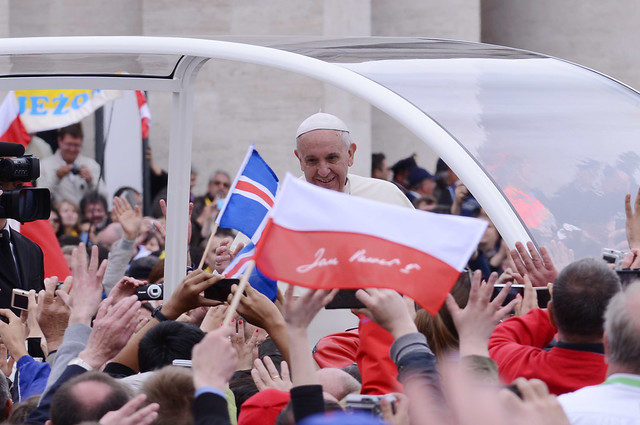
Canonization 2014- The Canonization of Saint John XXIII and Saint John Paul II from Flickr via Wylio
© 2014 Aleteia Image Department, Flickr | CC-BY-SA | via Wylio
The Green family, good doctrinaire Catholics that they are, could really take a good lesson from Francis on focus. Because Francis really gets where our energies as Christians need to be turned primarily.

Also, I love his willingness to challenge long-hold ideas about how Christians and Catholics are supposed to think about the world. Can you imagine John Paul II or Benedict saying anything about Communism that wasn't centered around a scathing denouncement?

Elizabeth Stoker Bruening captures the conservative American Christian's relationship with politics and theology:
You don’t have to do much googling to find hand-wringing over whether or not Pope Francis is a Marxist, Leninist, communist — or some other permutation of politically charged bad guy. These accusations are never meant to argue seriously; they’re smears, they’re an attempt to take a claim that is radical and domesticate it, make it familiar and digestible to an audience that doesn’t want to deal with a disrupted political narrative. It is quite flatly uncomfortable to imagine politics to be the province of Christian ethics, and economics at that; it is troubling to think the eye of God peers into the market, where some other invisible hand is usually the preferred deity. It is easier to pretend Pope Francis’ ethical analyses of economics aren’t religious, that they’re purely of a secular vein of prima facie rejected political orders still coasting along in collective middle American nightmares on the bad fumes of the Cold War. The Pope is a Marxist! isn’t the whole narrative, it’s just a metonymy; the narrative is: The Pope is a Marxist because he claims poverty is injustice and that it can be corrected in part through state activity, and we all know this Marxist diagnosis is unChristian and unAmerican and wrong.

Absolutely right. The major sickness of American Christianity, summed up in one paragraph.

Tuesday, July 1, 2014

On Hobby Lobby and the Ongoing War on Women

I have a lot of thoughts about the Hobby Lobby ruling yesterday, most of them centered on the ridiculously wrong medical science behind the Green family's case and the absolutely insane idea that my employer has any right to say what I do with my earned benefits once it leaves their bank account. Not to mention the heartbreak I feel for the 14% of women in this country who use birth control and IUDs for purposes other than contraception, mostly life-threatening medical conditions, who now have to hope and pray  that their right to a healthy and long life doesn't violate their employer's "religious liberty." It's disgusting.

Hobby Lobby in Ashland, KY from Flickr via Wylio
© 2012 Nicholas Eckhart, Flickr | CC-BY | via Wylio
But, I want to focus on another issue that has gained more relevance for me since this ruling yesterday morning. Let me explain it this way: when I go to a job interview, that interviewer is generally only evaluating my previous work experience, my strengths and weaknesses, and my background. My race or gender isn't even thought of in any way. When I go to the doctor, no one questions the decisions I make with my doctor in any way. When I make a decision to work long hours despite having two kids, no one considers me a bad or deficient parent, or worries about my kids being abandoned.

The point is, as a white man in America, my identity never plays a role in the decisions and privileges I get in life. I never have to worry about any other consideration. I'm very lucky in that way.

And I'm also in a vast minority. Because, as a white Christian male, I am the only demographic in America that doesn't deal with inherent systematic bias in life. The Hobby Lobby decision is just another point of evidence in that contention.

When I purchase health insurance through an employer, I never have to wonder if everything I select will be paid for. I can get any medical service I deem necessary. If I want a vasectomy (eliminating my own ability to reproduce) I know my employer will pay for it via my insurance, no harm no foul. When I go down to my local M.D. to get the procedure done, I will not have protesters standing in front of me crying for all the little unborn babies never getting a chance at life because of my choice.

Women don't get that kind of freedom. Their health choices are always open for questioning and criticism. Their ability to make reproductive choices is the most hotly contested political issue of the last half-century. And now, they have to wonder if the health care they thought they were signing up for access to will still be there when they need it.

Not to mention, their ability to land jobs is tied to whether or not they are pregnant, are likely to become pregnant, or have children at home. Their ability to do a job is questioned by those who wonder if they are "tough enough" or "have thick enough skin" to "Run with the big boys." Their mothering skills are questioned if they have the gall to pursue higher education or spend a few more minutes at the office.

And I have even mentioned that the career I have chosen, that of ministry, isn't even open to a huge number of women in this country? Whereas I can become a minster in any denomination that I feel I belong to, women have to limit that choice. I heard a young women recently tell a story, with tears in her eyes, about how she was just a little child when she heard her newly-ordained brother preach in the local Southern Baptist church. At that moment, she felt a calling on her life, a passion to follow her brother and become a representative of the church in this world. And instead of open arms and pride, her family rejected her calling and told her she was wrong and sinful for feeling a calling from God, because she is a woman. Thank God she has found a new home in the UMC where she is welcome to follow her calling.

As Christians, we shoulder a large load of blame in the oppression and degradation of women. For too long, we told women they were too dirty and broken to be a representative of God to others, among other pursuits and dreams. Even if many of our churches have opened their pulpits to women, many others, including the two largest Christian denominations in the United States, still refuse to do so, for no other good reason than they are women, and the old men running these churches are scared too death of a woman having any authority against them in any way.

There is only one way to live a Christians, and this is with radical love, acceptance, and equality. Yesterday's ruling, and more importantly the attitude it engenders and perpetuates toward women, is anything but Christian in nature.

The war on women in America is alive and well. Anyone who thinks otherwise is blind to the world around them.

Thursday, June 19, 2014

God as the Clockmaker: Thinking Through Deism and an Active God

Next week, I travel to Lincoln, NE to attend a Candidacy Summit for ordination candidates in the Great Plains conference. This will be a great opportunity to learn and fellowship and connect with others who are on the same journey I am on right now.

In order to afford the expense of this trip while living on a single income, I set up a GoFundMe page to raise money. Earlier today, I easily rolled past the goal I had set. The gifts I received from so many are wonderful and gladly accepted. It's heartening to know all the support I have as I begin this new phase of life.

I want to meditate here for just a minute on the blessing from God that this money really is, and how I reconcile that in my mind.

My understanding of the active nature of God generally falls along the "Clockmaker" line of thinking. (I have in fact self-identified as a deist in the past.) In my view, God set up an orderly, rational universe that moves according to the laws of nature as initiated by God. God wants us to understand the world around us, so that we might not live in fear and darkness, so he lets the world run according to nature. He may not cause hurricanes, but he doesn't stop them either, and he has given us brains and abilities to be able to avoid and survive the worst nature has to offer.

(I don't, however, subscribe to the traditional clockmaker doctrine of predestination. God set the world into motion, but gave us free will to act. We have bearing upon the operation of the clock, and can but positively and negatively influence it's operation. "Clock" refers to the world we live in. This is convoluted, I know. I'm not the most coherent theologian yet. I'll get there.)

Let me explain. I don't say this to mean God is uninterested and checked out on human kind. Quite the contrary. I believe he is intimately concerned with us and our actions. But I don't think God actively interferes in the day-to-day happenings of out lives. I don't think God magically "heals" the sick from heaven, or pushes our car a little farther forward to avoid the oncoming semi. I think a God who would do these things is a sick God. Because everyday millions of people suffer and die from illness, car wrecks, poverty, war, and a million other reasons. Thus, a God who chooses to save some but refuse to act in the case of others is a cold-hearted God who is anything but "all-merciful."

So in the past, I abstained from crediting any earthly happening to the hand of God.

But I'm starting to acknowledge some nuance in my view.

This money that I have received is truly an example God providing, of God making something that seemed impossible, possible, in an active way. Without these donations, I could not go to Lincoln and continue on my journey of ordination. But, through trusting in the goodness of others inspired by the spirit of charity that God imbues in us all, I can make the trip. Through this, God has led me to the proper path for my life.

Think of it in contrast to past attempts at fundraising on my part. As many of you know, last year, I briefly campaigned for elected office in Oklahoma. "Campaigning" mostly consisted of making phone calls asking people for money. I was terrible at this. I didn't raise much money at all. I was awkward and uncomfortable and needless to say, didn't pursue campaigning for very long. Fundraising in that way is not a gift I have.

And that is a commentary on God leading me in life. I was created and born with certain gifts and abilities. As I grow and learn and realize who I am, I awaken to those gifts and abilities and recognize my proper place in the world. And that has lead me to ministry.

To say that God played no active part in this guidance is to deny the existence of God.

God may not have reached into people's bank account and moved money. He didn't whisper in my ear saying "You should go into ministry." But God's mark is all over my journey. And that is the true essence of a "Great Clockmaker." Even in things that seems completely disassociated from any mention of God, God's touch is still present in the very existence of those things.

Thanks again to everyone who donated, and keep an eye out here for my thoughts and experiences during the Candidacy Summit next Friday and Saturday in Lincoln.

How Do Methodists Stay "United" in the Face of Action on the LGBT Question? Examining Brian McLaren's prescription for the UMC

Rachel Held Evan's most recent "Ask..." featured Brian McLaren, the great Christian author and thinker.
Brian touched on a lot of great issues, which I may or may not comment on more in a future post. But for now, I want to focus on the last question and answer. Here is the question:
From Cindy: As my denomination (United Methodist) continues to tear itself apart over how we will or won't receive LGBTQ people in our midst, I despair that the losers in our struggle will be the poor and other marginalized people, who Jesus called us to be in ministry with. If you got to set a course for how we (and other denominations) could navigate through these choppy waters, what would it be?
Brian's answer is good and thought out, and basically amounts to: gay people are here, and they aren't going anywhere, and they are born to conservatives and progressives and Episcopals and Methodists and Baptists and simply closing our eyes and refusing to accept that fact will change none of this.

But I want to focus on his prescription for the UMC specifically going forward. Here is what he suggests:

But if I "got" (or was held at gunpoint and forced) to set the course, here's one approach I would consider. From the start, I'd propose at least four or five options, not just two. When people are forced to choose between two options, they often fail to see the full range of consequences because they are only afraid of avoiding the opposite choice's consequences. So options might be …
A. We accept LGBTQ people as equal, and accept that a significant percentage of people will leave, especially older and more dedicated donors, which will have results in closing seminaries, stopping mission to needy people, spending millions on lawyers, etc., etc.
B. We keep our conservative position but make allowances for congregations or conferences that differ, knowing that we will lose some people who will be against any compromise.
C. We accept a progressive position but make allowances for congregations or conferences that differ, knowing that we will lose some people who will be against any compromise.
D. We refuse to accept LGBTQ people as equal, and accept that a significant percentage of people will leave, especially younger and more educated people, which will have results in closing seminaries, stopping mission to needy people, spending millions on lawyers, etc., etc.
E. We allow current conservative regulations to continue and we create a mechanism for people to violate those regulations to remain, knowing that some people on both sides will leave because they disapprove of this option.
Then, I would institute a brief but intense study period to estimate the consequences of each option. I would spend the money on professional researches to conduct surveys so the results would be data-based.
Then, I would develop a way for the denomination to make a choice among options … with the estimated costs and benefits clearly articulated. I would also build in a review period with an opportunity to make corrections to whichever path was chosen based on unforeseen consequences that must be addressed.
I should say that I would consider a completely different line of approach as well. In that approach, I would invite the denomination not to solve this problem, but to see this problem as a symptom of much larger and deeper problems. In that light, I would invite the denomination to consider a historic restructuring - no, more radical than that, a historic re-founding.
Because at the end of the day, denominational structures are all under stress, even considered completely apart from this issue. Post offices, record labels, publishing companies, book stores, TV networks, travel agencies, education systems, economic systems, even governments are all under stress because they have transformed the conditions under which they were created. The church is not alone in facing these epochal shifts in culture. Almost all (maybe all?) institutions are in a period of stress, which is the critical ingredient of evolution … or extinction. 

This is what I really like about Brian. He does a really great job of analyzing something from all points of view, and articulating those in a way that people on all sides can understand.

I want to run through his options here, but first, let me unequivocally state: I am strongly, strongly against the idea of schism within the UMC. I think unity is an essential part of carrying the message of Christ into the world. And one of the wonderful things about Methodism is we have historically been a "big-tent" denomination. You can see the diversity of our church not just at the General Conference level, but also with Annual Conferences and even Districts. There is no problem so difficult that it transcends our bonds as brothers and sisters in Christ.

That said, I know Methodists on both sides of the debate disagree with me, and believe that separation is the best way to preserve the calling of our consciences on this, and other, issues. And despite the best efforts and best intentions of those of us in the "unity" camp, we simply can't force anyone to stay. So this conversation of how to we move forward is unavoidable and extremely necessary.

With option "A", McLaren suggests we accept LGBT people as unequivocally equal. Personally, I believe this is the best way forward for the church. Accepting LGBT persons into the life of the church with no distinctions made between them or you or I is the only way to accurately reflect the radical equality and hospitality lived by our example, Jesus. LGBT people should be allowed to marry their partner, because loving, committed monogamous relationships are what we should be encourgaing. They should be allowed ordination. There should be no minority groups or people with suppressed rights in the church, as we are to reflect the egalitarian, love-filled kingdom of Christ on earth.

Option A, however, is probably a long shot for the UMC right now. The worldwide church membership is moving towards a fully-inclusive position quickly, but there is still a powerful and loud minority in opposition both at the leadership level, and at the congregational level. And, contrary to the stated beliefs of some, this opposition isn't anchored primarily in Africa. There is a powerful contingent right here in North America that we are going to have to contend with going forward.

So the remaining four options are, I believe, much more likely. But not equally so. I want to tackle in order of what I see as the least likely to the most likely course of action for the General Conference to take.

Option D basically amounts to inaction. Not gonna happen. The issue has been discussed and dissected and argued and grappled with from all angles. Open letters have been written, ideas presented. The fact is, something is going to change at General Conference. Standing pat is an option no one, not even conservatives, will be happy with.

Not only is it highly unlikely, I think doing nothing would be irrevocably damaging to the church. Taking a pass on action would signal to many that the church is unwilling to speak relevantly and responsively to the needs of it's membership. Trust in our ability to grapple with tough issues would be seriously eroded, and the four years following 2016 would see even more acrimonious bickering, and almost certainly, major schism, probably on the part of progressives who feel the church is abdicating it's responsibility. I think their attitude would have merit. The UMC's days as a unified denomination would certainly be numbered.

Let's pray and pray that no matter what happens, the church takes some action on the LGBT question.

I place Option E next. I just don't know how we would square the circle, so to speak, of turning a blind eye to regulations still on the books. We've seen with the actions of people like Frank Schaefer over the last few months that no matter the intentions or situations, there is a hard-core, devoted group who will search out and publicize every inclusive action taken by progressives on LGBT issues and make it a denomination-wide issue. And frankly, if we take the Book of Discipline seriously, the having a "wink, wink, nod nod" attitude to the flouting of regulations is no solution at all. Institutional acceptance of these actions moves us forward in no way. Right now, when people like Rev. Schaefer act, it acts as a stimulus to spur the church towards action on a justice issue, even as it violates our Discipline. If we leave the regulations in place, but refuse to enforce them, we are weakening the church by refusing to take a stand both on LGBT issues and on our ability to police ourselves. Option E is an easy way out, but certainly not a good one.

That leaves with us two options that are mirrored opposites of one another. We can either affirm a conservative stance on the issue theologically while allowing local polity's to handle specific situations in a way best for them, or we can affirm a progressive theology while taking the same action. It's basically the same move, but it will come down to a tug-of-war to see which side can move enough votes to not only affirm their position, but strike down the other.

So which do I see as more likely? Being the eternal optimist I am, I think the church will affirm progressive theology while allowing local autonomy on this issues. I think this is about numbers and trends. It's clear which way the winds are blowing in both our denomination, and in our culture at large. Our church knows it needs to respond in a effective way to the majority of members who now accept LGBT equality. But if we are to maintain unity, we can't do it in a way that ignores our more conservative brothers and sisters or leaves them behind.

Like I said at the outset, I think full equality is our future, as it rightfully should be. But we have to get there in a way that preserves the UMC and nudges those who need nudging in the right direction. Affirming equality would place the church in the correct place theologically speaking. But allowing local congregations who are not there yet to come along at their own pace is crucial to any diverse and broad coalition. We can't force this on people who feel they are following the dictates of their conscience (and thus God.) That will only drive them away. But allowing them to come to us, and showing them that equality is an unmitigated positive that doesn't destroy churches, is the only choice we have.

That said, a theology of equality demands that we present that face to the world. Thus, I would strongly suggest a companion amendment that condemns openly-homophobic or anti-LGBT statements and actions from UMC member churches and clergy. This shouldn't be construed as a gag order in any way, but merely a confirmation that no matter what one's views on homosexuality and gay marriage are, any statement or action that hurts or damages the humanity and well being of others is not Christian in nature. You can abstain from participating in LGBT marriages, and be unwilling to host an LGBT minister, but you don't need to be flooding the airwaves with out and out homophobia under the Methodist banner.

As Brian says, this won't placate everyone. People will still leave. As you can see in his options, this happens no matter what action is taken. The key is, what action can we take that absolutely minimizes the bleeding that will occur?

Like Brian, I think the refusal of many to accept LGBT equality is symptomatic of a larger ill at work in the Christian faith. As disciples of Jesus, we are called to emulate his example in the world, and that means radical inclusivity, hospitality, and equality. We have to recognize that if we are going to be His hands and feet in the world, then welcoming all into our embrace is essential. Otherwise, we are failing in our Christian duty to affirm the worth of all people, and the image of God they were created in and carry in them.

Brian wraps it up with a compelling statement on the need of the church, like any other institution to grapple with tough issues and evolve in a way that is true to both the shareholders involved and the traditions embodied in any such institution. The key word he uses is "Evolution." As much as I would like to see this church take a completely open and affirming stance right now, the pragmatist knows that evolution doesn't happen in large, sweeping actions, but instead in grinding, inevitable baby steps.

The UMC is too forward thinking and relevant to not "get there" on equality. Whether or not it will happen is not the issue. It all revolves around the how we do it, the timeline it takes, and whether we can still be "United" Methodists when we come out on the other side.

Wednesday, May 28, 2014

Not One More

I really feel for Richard Martinez. His reaction is what I believe my own would be in his situation: abject grief and anger at the insanity of our gun and violence culture. Watching him break down and cry is almost too much for this father to handle.


CNN

Mr. Martinez lost his son Chris in the UCSB shooting this weekend. Since then, his words of grief and anger have become the face of the reaction to this tragedy.
“I don’t care about your sympathy. I don’t give a s--- that you feel sorry for me,” Richard Martinez said during an extensive interview, his face flushed as tears rolled down. “Get to work and do something. I’ll tell the president the same thing if he calls me. Getting a call from a politician doesn’t impress me.” 
Saying that “we are all to blame” for the death of his 20-year-old son, Martinez urged the public to join him in demanding “immediate action” from members of Congress and President Obama to curb gun violence by passing stricter gun-control laws. 
“Today, I’m going to ask every person I can find to send a postcard to every politician they can think of with three words on it: ‘Not one more,’ ” he said Tuesday. “People are looking for something to do. I’m asking people to stand up for something. Enough is enough.”
This father shouldn't have to be mourning his son. In a sane world, he wouldn't be.

We have to do something about these all-too-common mass murders. It's not just about banning guns or improving mental health services. It's about changing a culture that accepts violent weapons and gun violence as necessary components of a "free society." We have to make people, and especially children, understand that violence is wrong and weapons are not glamorous. We have to change the overwhelming cultural acceptance of violence as something that is routine and normal, instead of insane and rare. It means we have to reduce the influence of guns, of violent media, of "tough guy" machismo parenting and child rearing. We have to teach peaceful resolution of conflicts, and help young men and women understand that violence gets you nowhere. We have to withdraw media attention from the shooters, and turn it on people like Richard, and on the memories of those who unfairly lost their lives.

I remember the day of the Sandy Hook shootings, less than a month after the birth of Julian, of the very real fear and anger I felt while watching the news that innocent children had been gunned down. Feeling so sad for their parents and almost in tears thinking about if I was in their shoes. Feeling that it was unfair that one day, I will have to worry about Julian and Evelyn when they are at school, not because they are struggling with a test or having a hard time making new friends, but because they might not make it home that day. Feeling shaken and angry that our nation appears to feel the need for action, but then just shrugs and moves on. No parent should have to experience what Richard Martinez is going through. No parent should have to get a phone call from a grade school telling them their kindergartner has been shot to death. No new parent should have to watch the unfolding news of 20 dead children and fear for their child's future. Something needs to change.

Wednesday, April 9, 2014

Stepping Back and Reassessing

You may have noticed a certain silence here recently.

I know you're all very perceptive like that.

There are several reasons for the silence, all of which I hope you agree are valid ones. First and foremost, I started a new job. During the time when I was blogging regularly, I was unemployed. Which meant I had lots of time to sit around and type. Not so much anymore. I have a job that I love that keeps me very busy, and in the free time I do get, I like to spend time with the wife and kid.

Secondly, and perhaps more importantly, I was getting particularly unhappy with what I was posting here. Not that I didn't think it was good; I did and do. But I think in the drive to post on a regular schedule, I was forcing things a bit. I've had this problem in the past. I force content to drive traffic, but sacrifice saying things insightful or organic. It becomes more of job. It's a fine balance as a blogger, you know. You want to post regularly to keep your readers informed and involved, but you don't want to become stale in the interest of just being here. I crossed that line I think.

So I want to change course a little bit. I am evolving spiritually in my life. I want my writing to reflect that. I'm not necessarily just interested in the intersection of politics and religions. My interests far exceed that. I have been thinking a lot about heaven and hell, about the historical Jesus, about what form God's justice takes, about the meaning of Easter, about atheism. I have been reading CS Lewis and Robin Myers and thinking about Wendell Berry and Albert Schweitzer. The places where I am in my head, that's where I want this blog to be. Because writing is cathartic for me. It's a way to get all these thoughts that are bursting my brain out and to get feedback and to develop.

Forced writing doesn't do that.

In light of all that, here are some things that are changing. First, the name. I've left it alone for now. But I am trying to think of something a bit more apt for what I want to do here. I am open to suggestions, and once I make a choice, I'll be sure to explain the context.

Next, I'm not going to guarantee a schedule. You might not hear from me for a couple days, the I may blast you with six posts in a day. Sorry in advance about that. I'll try to spread stuff out. But expect more authenticity and spiritual musing and passion. Posts may become much more stream-of-consciousness based, much more devotional, or much shorter. I may just throw raw thoughts out for kicks. What I'm saying is, I'm gonna keep you on your toes. Keep checking in to see what's new, and please, please participate. I want feedback and disagreement and criticism and discussion. It builds my arguments and my faith, and I'm confident it will do the same for you.

I'm planning on continuing the Sermon on the Mount series, though the focus may shift a bit. But hopefully you all continue to find it enlightening and thought-provoking.

Thanks for you patience, and your loyalty,

-Justin